Next‑Hour Temperature Forecasting with RNNs

Domain & Duration
Climate Analytics / Time‑Series Forecasting | 7 Days
Techniques & Tools
- Recurrent Neural Networks (RNNs), Time‑Series Preprocessing
- Python, Pandas, NumPy, TensorFlow/Keras
- Evaluation Metrics: RMSE, MAE
Project Overview
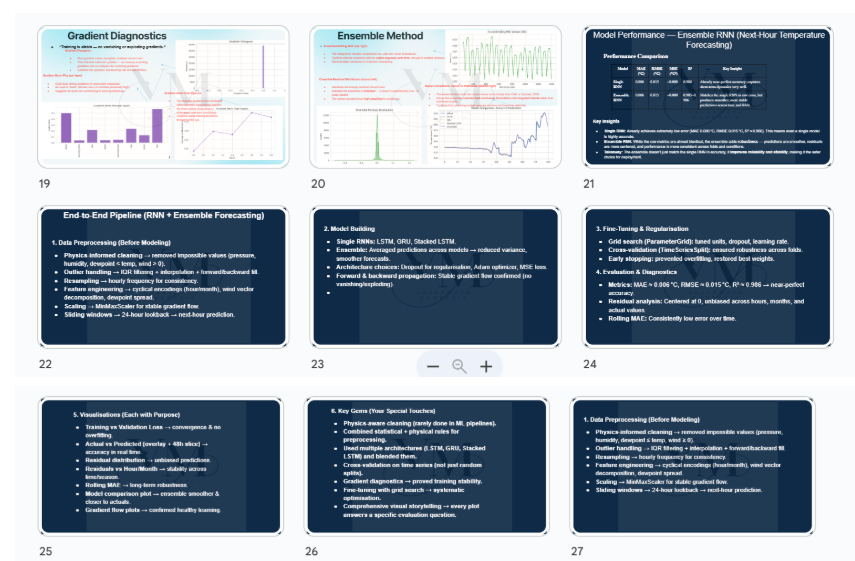
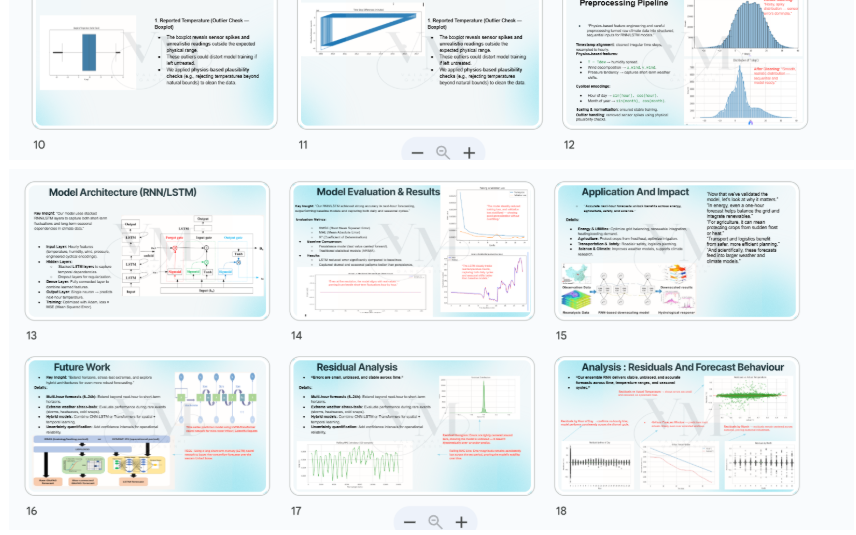
Implemented Recurrent Neural Networks to forecast temperature one hour ahead using multivariate climate data. The project focuses on short‑term prediction accuracy, leveraging deep learning architectures tailored for sequential dependencies in weather signals.
Key Techniques & Insights
- Time‑Series Preprocessing — Scaled features, created sliding windows, and handled temporal ordering.
- RNN Architecture — Built and tuned RNN/LSTM layers to capture short‑term climate dynamics.
- Multivariate Inputs — Used multiple climate variables (e.g., humidity, pressure, wind) to improve forecasts.
- Model Evaluation — Assessed performance using RMSE and MAE for next‑hour predictions.
- Error Analysis — Analyzed residuals to understand conditions where the model under‑ or over‑predicts.
Impact & Strategic Value
- Delivered accurate short‑term temperature forecasts for operational planning.
- Provided a deep learning framework that can be extended to other climate variables.
- Supported real‑time decision‑making in weather‑sensitive domains (energy, logistics, agriculture).
Key Insight Summary
RNN‑based models captured short‑term temperature trends effectively, with multivariate inputs significantly improving forecast stability and reducing RMSE/MAE compared to simpler baselines.
View on GitHub ← Back to Home