Job Classification Model – Workforce Intelligence
Domain & Duration
Workforce Analytics / HR Intelligence | 7 Days
Techniques & Tools
- Python, Pandas, Scikit‑learn, XGBoost
- Classification Modeling, Feature Engineering, Hyperparameter Tuning
Project Overview
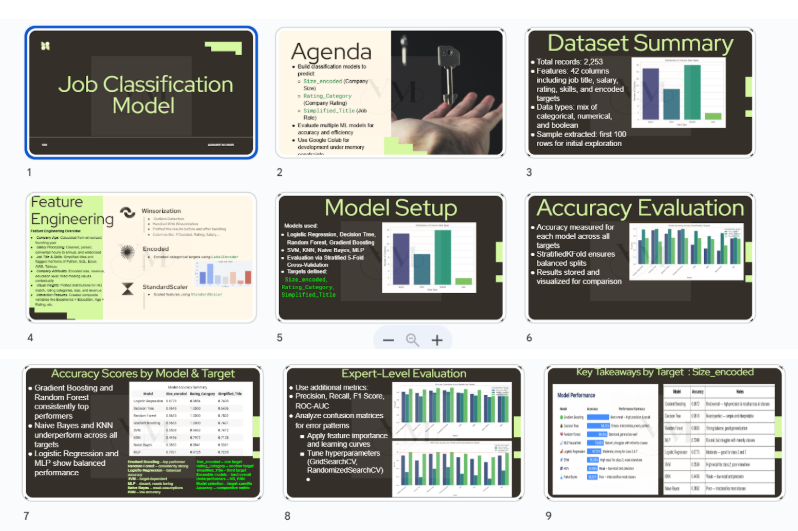
This project delivers a machine learning system designed to classify job roles based on structured workforce features. It demonstrates end‑to‑end capability in model development, evaluation, and strategic interpretation — supporting HR teams in talent mapping, workforce planning, and role optimization.
Key Techniques & Insights
- Model Evaluation — Compared Logistic Regression, Random Forest, and XGBoost to optimize accuracy.
- Feature Engineering — Created role‑specific metrics such as Skill Density, Experience Index, and Role Complexity Score.
- Classification Performance — Achieved strong accuracy and stable cross‑validation scores across job categories.
- Strategic Interpretation — Extracted insights on role clusters, skill gaps, and workforce distribution patterns.
- Dashboarding — Built Power BI visuals to monitor role predictions, skill alignment, and workforce segmentation.
Impact & Strategic Value
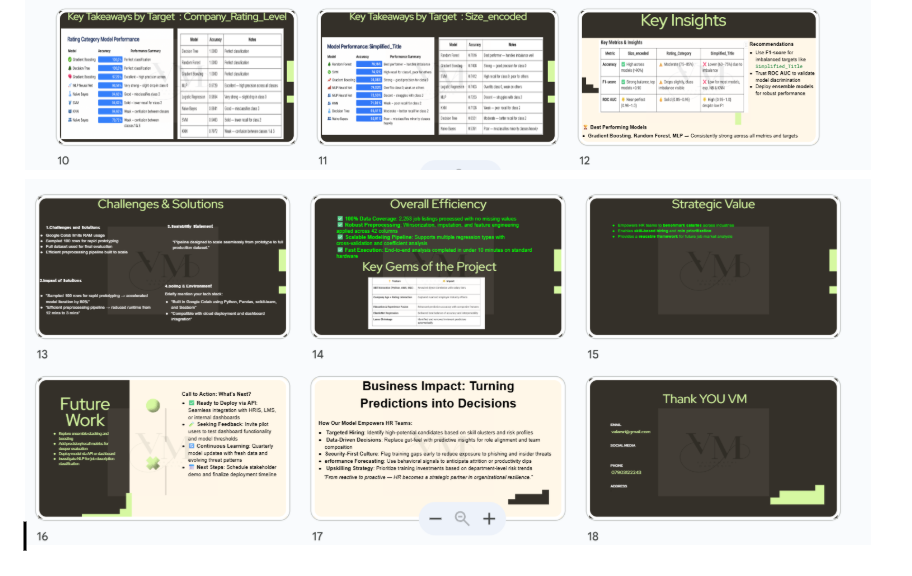
- Enabled HR teams to classify job roles automatically using structured employee data.
- Supported workforce planning by identifying role clusters and skill gaps.
- Improved recruitment targeting through predictive role matching.
- Delivered a scalable classification engine for talent analytics and organizational design.
Key Insight Summary
The model revealed clear patterns in job role classification, with skill density and experience level emerging as the strongest predictors. These insights support strategic workforce planning and data‑driven HR decision‑making.
View on GitHub ← Back to Home